
Why Most Digital Transformation Projects in India Fail in the First 90 Days


Digital transformation has become one of the biggest priorities for Indian businesses today. Every company wants automation, better reporting, faster operations, real-time visibility, AI-powered insights, and centralised systems. Manufacturing companies want ERP platforms. Sales teams want CRM systems. Management wants dashboards and data-driven decisions.
Across India, businesses are investing heavily in digital tools because they understand one thing clearly. Companies that fail to modernise operations will struggle to compete in the coming years.
But despite all the investment and excitement, there is one uncomfortable reality that many businesses do not openly talk about.
A large number of digital transformation projects fail within the first 90 days.
Some projects completely stop midway. Some companies return to Excel sheets and manual processes. Some teams stop using the software properly. In other cases, the software remains active, but employees use only 20% of its actual capabilities.
And surprisingly, most of these failures do not happen because the software is bad.
The real problem is that many businesses are not fully prepared for the transformation itself.
Most Companies Think Digital Transformation Means “Buying Software”

This is probably the biggest misunderstanding.
Many businesses believe digital transformation simply means:
Purchasing ERP software
Implementing CRM
Moving reports to dashboards
Automating approvals
Using AI tools
But real digital transformation is much deeper than technology.
It changes how departments communicate. It changes approval structures. It changes accountability. It changes reporting methods. It changes operational discipline. Most importantly, it changes people’s daily working habits.
And honestly, that is where the real challenge begins.
Buying software is easy.
Changing organisational behaviour is difficult.
The Excitement During Demo Phase Is Very Different from Real Implementation

In most Indian companies, the first few weeks of a digital transformation project feel extremely positive.
There will be:
Product demos
Management discussions
Vendor presentations
Automation plans
Dashboard expectations
Scalability conversations
Everyone feels excited because finally, the company is moving towards something modern.
But once implementation begins, reality starts becoming visible.
Suddenly, teams realise:
Different departments follow different workflows
Important data is missing
Excel sheets exist everywhere
Reporting formats are inconsistent
Approvals happen through phone calls
Customer information is scattered across multiple files
Teams depend heavily on WhatsApp communication
This is usually the stage where confusion starts.
The software expects structured workflows, but the business itself is operating through informal coordination and manual dependencies.
And that creates friction immediately.
For example, one manufacturing company in Chennai implemented ERP to improve inventory and production tracking. During the demo stage, management was highly confident about automation. But after implementation, the purchase department continued maintaining separate Excel files, warehouse teams updated stock manually in notebooks, and accounts teams waited for WhatsApp confirmations before processing entries.
Within two months, inventory reports stopped matching. Production blamed stores. Stores blamed accounts. Management blamed the ERP vendor.
But the actual issue was not the software.
The company had implemented technology without changing internal working habits.
Most Businesses Don’t Fully Understand Their Own Process

This is one of the biggest reasons digital transformation projects fail early.
Many companies approach ERP or CRM implementation without properly documenting their operational workflow.
A company may simply say:
“We need ERP for better tracking.”
But once implementation meetings begin, even basic questions create confusion.
How does procurement approval happen?
Who updates inventory?
How is production planning managed?
Who approves discounts?
Where is customer data maintained?
And surprisingly, different departments often give different answers for the same process. That is when businesses realise they have been running operations based on informal coordination rather than a clearly structured workflow.
This situation is extremely common in growing Indian businesses.
Over the years, operations have expanded rapidly. Teams somehow adjust and continue working based on experience and verbal understanding. Since the business is functioning, management assumes the process is stable.
But software implementation exposes every operational gap very quickly.
I once saw a company where sales order approvals happened entirely through management phone calls. Employees understood the internal process because they had worked there for years. But during ERP implementation, nobody could clearly explain the actual approval hierarchy because nothing was documented properly.
The company initially thought they had a software problem.
Later, they realised they actually had a process clarity problem.
The “Jugaad” Mindset Creates Long-Term Operational Damage
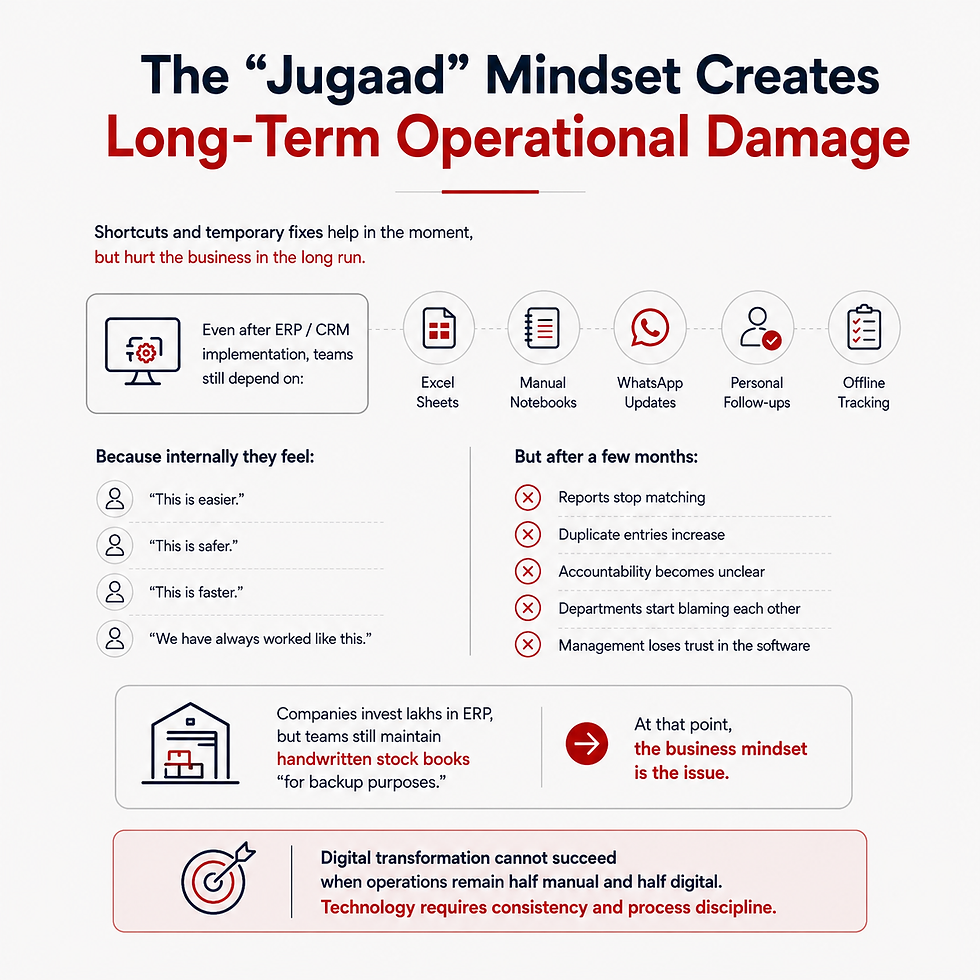
This is something very common in Indian business culture.
Many organisations are used to solving operational problems through shortcuts and temporary adjustments. In some situations, this flexibility helps businesses survive challenges quickly.
But during digital transformation, the same mindset becomes dangerous.
Even after ERP or CRM implementation, employees continue depending on:
Excel sheets
Manual notebooks
WhatsApp updates
Personal follow-up systems
Offline tracking methods
Because internally they feel:“This is easier.”“This is safer.”“This is faster.”“We have always worked like this.”
Initially, these shortcuts may not look serious.
But after a few months:
Reports stop matching
Duplicate entries increase
Accountability becomes unclear
Departments start blaming each other
Management loses trust in the software
I have personally seen companies invest lakhs in ERP implementation while warehouse teams still maintain handwritten stock books separately “for backup purposes.”
At that point, the software is not the issue.
The business mindset is the issue.
Digital transformation cannot succeed when operations remain half manual and half digital.
Technology requires consistency and process discipline.
Management Often Wants Immediate Results
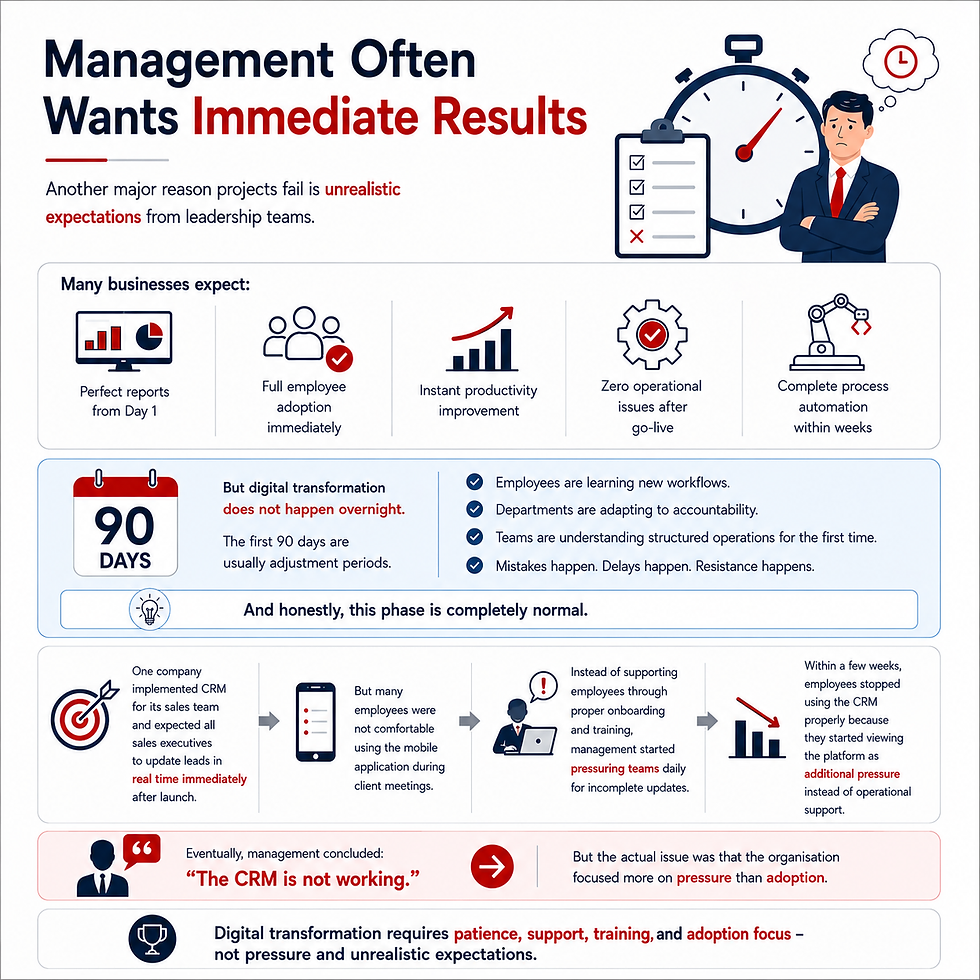
Another major reason projects fail is unrealistic expectations from leadership teams.
Many businesses expect:
Perfect reports from Day 1
Full employee adoption immediately
Instant productivity improvement
Zero operational issues after go-live
Complete process automation within weeks
But digital transformation does not happen overnight.
The first 90 days are usually adjustment periods.
Employees are learning new workflows. Departments are adapting to accountability. Teams are understanding structured operations for the first time. Mistakes happen. Delays happen. Resistance happens.
And honestly, this phase is completely normal.
One company implemented CRM for its sales team and expected all sales executives to update leads in real time immediately after launch. But many employees were not comfortable using the mobile application during client meetings. Instead of supporting employees through proper onboarding and training, management started pressuring teams daily for incomplete updates.
Within a few weeks, employees stopped using the CRM properly because they started viewing the platform as additional pressure instead of operational support.
Eventually, management concluded:
“The CRM is not working.”
But the actual issue was that the organisation focused more on pressure than adoption.
Employees Are Rarely Included Properly

One of the biggest mistakes companies make is involving only top management during software discussions.
But the actual users are:
Sales executives
Accounts staff
Purchase teams
Production coordinators
Service engineers
Operations teams
These employees understand the real operational challenges better than anyone else because they deal with the process daily.
Still, in many companies, their inputs are ignored during requirement gathering sessions.
Later, management wonders why employees are not using the software properly.
A CRM platform may look excellent during demo presentations. But if sales executives feel lead updates take too much time, they eventually stop using it consistently.
Then management starts saying:
“The CRM is not working properly.”
Actually, the adoption strategy failed.
There is a huge difference between software failure and user adoption failure.
Over-Customisation Slowly Destroys User Adoption

Another major issue is over-customisation.
Instead of improving workflows, many companies try to recreate old manual habits digitally.
Every department asks for exceptions. Additional approvals get added continuously. Extra fields increase. Existing inefficiencies get copied directly into the system.
Eventually, the software becomes complicated for everyone.
One company requested more than 40 customised fields inside their CRM because every department wanted “just one additional requirement.”
After implementation, even basic lead entry became time-consuming. Sales executives became frustrated and slowly shifted back to maintaining updates separately in Excel.
The software became operationally heavy instead of simplifying work.
Good digital transformation should simplify processes, not digitally recreate confusion.
Nobody Talks About the Emotional Side of Transformation
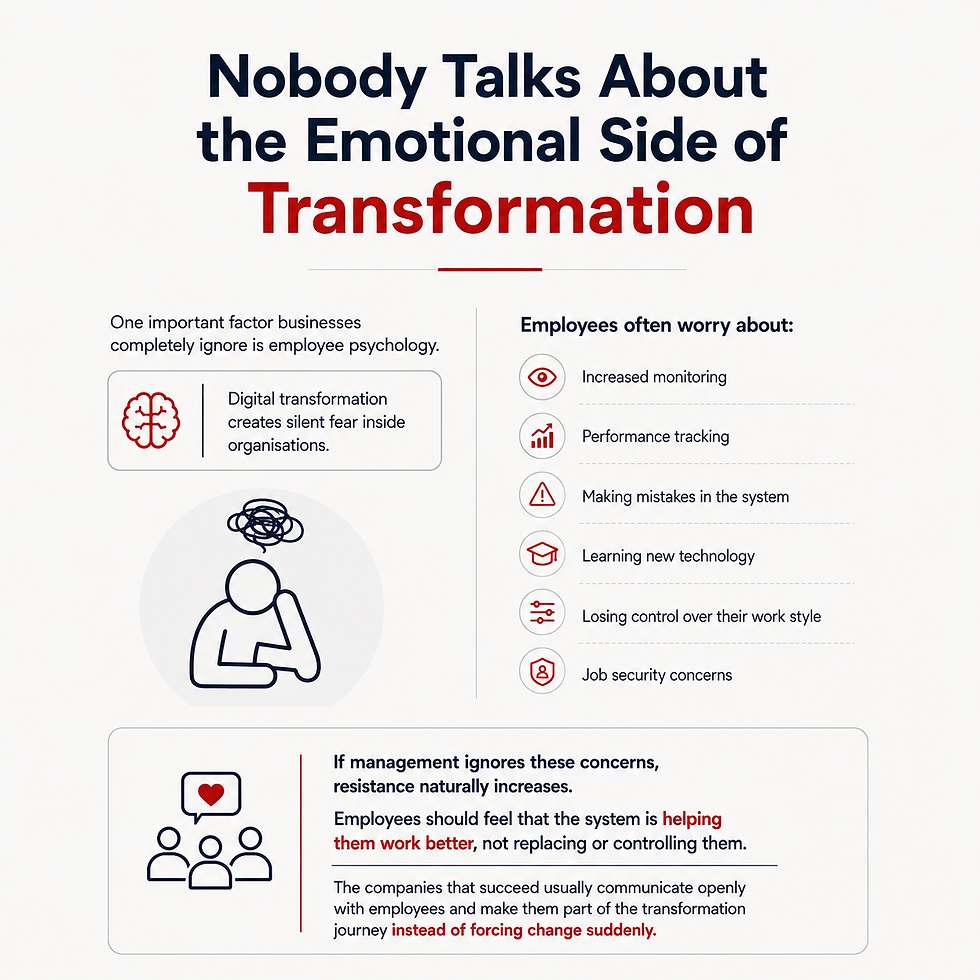
One important factor businesses completely ignore is employee psychology.
Digital transformation creates silent fear inside organisations.
Employees often worry about:
Increased monitoring
Performance tracking
Making mistakes in the system
Learning new technology
Losing control over their work style
Job security concerns
If management ignores these concerns, resistance naturally increases.
Employees should feel that the system is helping them work better, not replacing or controlling them.
The companies that succeed usually communicate openly with employees and make them part of the transformation journey instead of forcing change suddenly.
What Successful Companies Actually Do Differently

The companies that successfully complete digital transformation projects usually follow a very different approach.
They spend time understanding workflows before implementation. They document operational processes clearly. They involve employees from every department. They conduct detailed requirement gathering sessions. They focus on realistic expectations instead of quick results.
Most importantly, they understand one important truth.
Digital transformation is not an IT project.
It is a business transformation project.
Technology alone cannot solve operational confusion. Software becomes powerful only when people, processes, and leadership work together properly.
How We Approach Digital Transformation at Evanam Consulting
At Evanam Consulting, we strongly believe that successful digital transformation starts with understanding the business first, not the software first. Before suggesting ERP, CRM, CPQ, or any digital platform, we spend time understanding how the organisation actually works.
Our approach begins with:
Studying the complete business workflow
Understanding department-wise operations
Identifying operational gaps
Mapping approval structures
Documenting workflows through BPMN
Conducting requirement gathering sessions with every team
We do not believe in implementing software blindly.
We believe businesses need process clarity before automation.
Once the workflows are properly analysed, we help organisations choose the right solution based on their actual business requirements. This may include ERP systems, CRM platforms, CPQ solutions, Microsoft business applications, or custom workflow solutions.
Every business works differently, and successful digital transformation always starts with understanding the actual workflow behind the business. If you would like to explore how the right process and technology can support your operations, feel free to connect with us.
🌐 www.evanam.com 📧 hello@evanam.com 📱 +91 93639 77790


