
Why Production Delays Happen Even with Proper Planning


In many manufacturing organisations, production planning is carried out with a high level of discipline. Orders are scheduled, materials are arranged, and timelines are clearly defined. Whether in spreadsheets, ERP systems, or planning tools, everything appears structured and aligned for smooth execution.
However, once production begins, a different reality often emerges. Despite careful planning, timelines start slipping, coordination becomes more frequent, and teams find themselves adjusting continuously. This is not an isolated issue but a pattern observed across many growing manufacturing businesses.
The challenge, therefore, is not simply about planning better. It lies in understanding why well-prepared plans struggle during execution and why similar delays continue to repeat over time.
When Planning Meets Execution Reality
Production plans are typically built based on expected conditions. These include assumptions about material availability, machine performance, workforce efficiency, and coordination across departments. While these assumptions are necessary for planning, actual execution depends on real-world conditions, which are rarely as stable.
Even a minor variation in one area can affect the entire production flow. A delay in material arrival, a slight drop in machine efficiency, or a miscommunication between teams can gradually disrupt the schedule. When such variations are not anticipated or managed early, they accumulate and lead to noticeable delays.
Efficiency Without Flexibility
In an effort to improve efficiency, many businesses operate with minimal buffers. Inventory levels are tightly controlled, and procurement is aligned closely with production schedules. While this approach reduces holding costs, it also reduces the system’s ability to absorb disruptions.
Consider a situation where a critical raw material is expected from a vendor. The vendor dispatches on time, but a logistics delay occurs due to external factors. Since there is no buffer stock, production slows down or halts. What initially appears as a small delay at the supplier level quickly impacts the entire production schedule.
In such cases, the issue is not poor planning but the absence of flexibility within the plan.
Changing Priorities During Execution
Another common cause of production delays is the introduction of urgent or priority orders during ongoing operations. This is especially prevalent in businesses where maintaining customer relationships is critical.
For instance, a production line may be running as per schedule when a high-priority order is introduced. To accommodate this, the current process is paused, machines are recalibrated, and teams shift focus. While this may address an immediate business need, it disrupts the overall production flow.
When the original order resumes, the loss of continuity leads to increased setup time, reduced efficiency, and a higher possibility of errors. Over time, repeated interruptions of this nature create cumulative delays that are difficult to trace back to a single cause.
The Gap Between System Data and Shop Floor Reality

Modern manufacturing relies heavily on systems for planning and tracking. However, there is often a gap between what systems assume and what actually happens on the shop floor.
For example, a machine may be rated to operate at a certain efficiency level within the system. In practice, experienced operators may run it at slightly lower speeds to maintain quality or avoid breakdowns. These practical adjustments are necessary, but they create a difference between planned output and actual output.
When such variations are not reflected in the planning process, schedules are built on theoretical capacity rather than realistic performance. This leads to delays that are not caused by inefficiency, but by a mismatch between assumptions and reality.
The Impact of Rework on Production Flow
Production planning generally assumes smooth execution, but in reality, rework is a common occurrence. Quality deviations, even minor ones, require correction, which consumes additional time and resources.
Consider a batch that completes on schedule but fails a quality check. The units must be reworked, often using the same machines and manpower allocated for the next order. This disrupts the planned sequence and creates a chain reaction of delays.
Over time, such instances affect not just individual orders but the overall reliability of the production schedule.
The Human Element in Manufacturing

While systems and processes play a critical role, manufacturing remains heavily dependent on people. Workforce conditions, environmental factors, and local context all influence execution.
For example, during extreme weather conditions or local events, productivity levels may vary. Shift handovers may take longer, coordination may slow down, and overall pace may be affected. These are natural aspects of the operating environment.
When production plans do not account for such realities, execution begins to deviate from expectations.
Understanding the Real Problem
Production delays are often perceived as planning failures. However, in most cases, the issue lies in the gap between planning assumptions and execution conditions.
When planning does not fully align with how work actually happens on the shop floor, teams are forced to compensate in real time. This leads to increased coordination, delayed decisions, and gradual disruption of the schedule.
The problem, therefore, is not a lack of effort or intent, but a lack of alignment.
Moving Towards More Reliable Execution
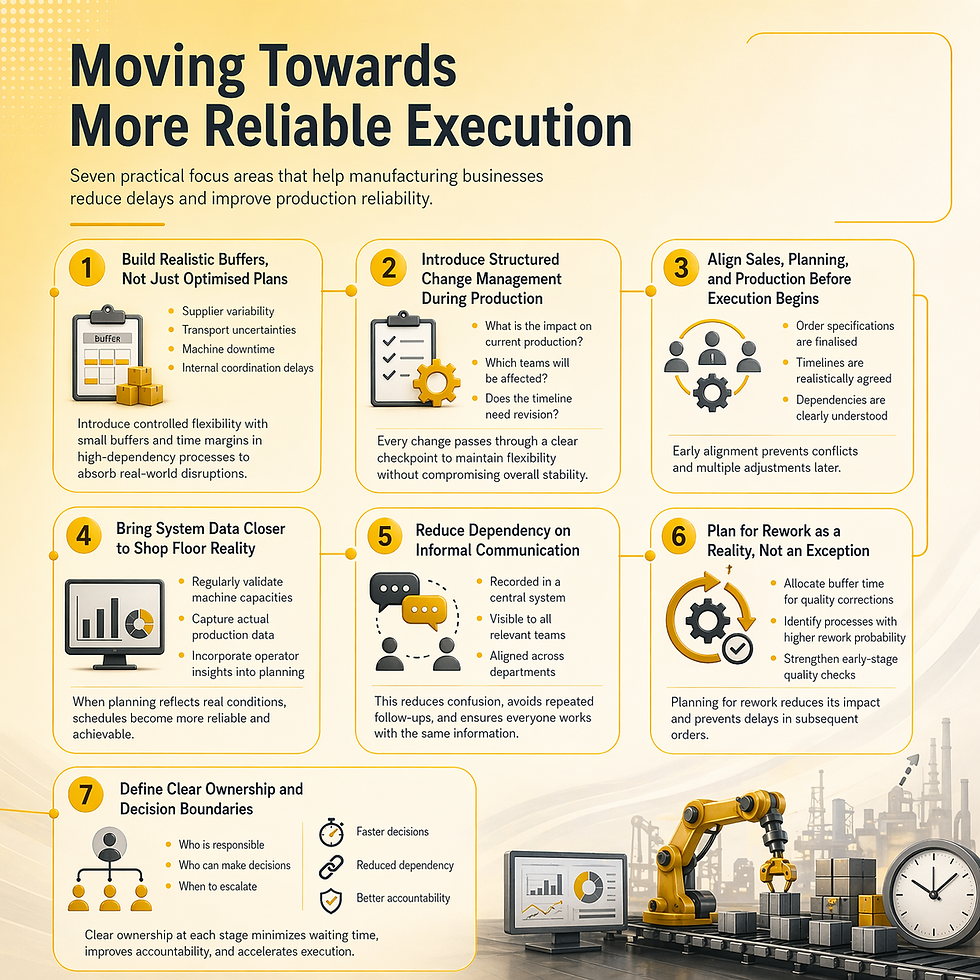
Improving production timelines is not about increasing pressure on teams or constantly revising plans. In most cases, the real improvement comes from strengthening how planning connects with execution on the ground.
For many manufacturing businesses, the gap is not visible in reports. It becomes visible only during daily operations, when teams are forced to adjust, follow up, and react to situations that were not anticipated.
To reduce delays consistently, businesses need to bring clarity and structure to a few critical areas.
1. Build Realistic Buffers, Not Just Optimised Plans
In an effort to improve efficiency, many organisations create tightly optimised schedules with little room for variation. While this looks effective on paper, it leaves no space to absorb real-world disruptions.
Instead of planning for ideal conditions, it is important to account for:
Supplier variability
Transport uncertainties
Machine downtime
Internal coordination delays
This does not mean over-planning or creating excess inventory. It means introducing controlled flexibility where it matters most.
For example, maintaining a small buffer for critical materials or adding slight time margins in high-dependency processes can prevent complete schedule disruption when minor issues occur.
2. Introduce Structured Change Management During Production
One of the biggest causes of delay is unstructured changes during execution.
Customer requests, priority orders, and internal adjustments are a reality in manufacturing. The issue arises when these changes are accepted informally without evaluating their impact.
Every change should pass through a simple but clear checkpoint:
What is the impact on current production?
Which teams will be affected?
Does the timeline need revision?
Even a quick structured review before accepting changes can prevent confusion later.
This ensures that flexibility is maintained, but not at the cost of overall stability.
3. Align Sales, Planning, and Production Before Execution Begins
Many delays originate from misalignment between departments.
Sales teams focus on customer commitments.
Production teams focus on execution feasibility.
Planning teams focus on schedules.
When these perspectives are not aligned early, conflicts appear during execution.
Before production begins, it is important to ensure:
Order specifications are finalised
Timelines are realistically agreed
Dependencies are clearly understood
A short alignment discussion before execution can prevent multiple adjustments later.
4. Bring System Data Closer to Shop Floor Reality
Planning systems are only as effective as the data they rely on.
If system assumptions do not reflect actual machine performance or process conditions, plans will always appear accurate but fail during execution.
To improve this:
Regularly validate machine capacities
Capture actual production data
Incorporate operator insights into planning
When planning reflects real conditions, schedules become more reliable and achievable.
5. Reduce Dependency on Informal Communication
In many organisations, critical updates are shared through calls, messages, or verbal instructions. While this may seem faster, it often leads to inconsistent information across teams.
Instead, key updates should be:
Recorded in a central system
Visible to all relevant teams
Aligned across departments
This reduces confusion, avoids repeated follow-ups, and ensures everyone works with the same information.
6. Plan for Rework as a Reality, Not an Exception
Rework is often treated as an unexpected event, but in reality, it is part of manufacturing.
Instead of ignoring it during planning, businesses should:
Allocate buffer time for quality corrections
Identify processes with higher rework probability
Strengthen early-stage quality checks
This reduces the cascading effect of rework on future schedules.
7. Define Clear Ownership and Decision Boundaries
Delays often increase when teams are unsure about:
Who is responsible
Who can make decisions
When to escalate
This leads to waiting time, repeated coordination, and slowed execution.
Clear ownership at each stage ensures:
Faster decisions
Reduced dependency
Better accountability
Even simple clarity in roles can significantly improve production flow.
From Planning to Reality
A well-prepared production plan is essential, but it is only the starting point. The true measure of effectiveness lies in how well the plan holds up under real operating conditions.
When businesses begin to recognise and address the gap between planning and execution, delays start to reduce naturally. Not because planning has improved significantly, but because the way the business operates has become more aligned, structured, and responsive.


