
The 7 Business Questions That Matter Before Choosing Any Software


Buying software often feels like a smart, responsible decision.
You’re trying to improve efficiency. You want better visibility. You want fewer mistakes and smoother operations. So you start researching tools. You watch demos. You compare features. You look at pricing. And at some point, it feels like choosing the software is the hard part.
In reality, that’s the easy part.
The hard part is making sure the software actually works for your business, not against it.
Because here’s a quiet truth most vendors won’t tell you:
Software doesn’t solve business problems on its own.
It only magnifies what already exists.
If your processes are clear, software makes them faster. If your processes are messy, software makes the mess permanent.
Before you invest in any software, accounting, CRM, ERP, HR, project management, or custom tools, pause and answer these seven questions honestly. They apply whether you’re a solo founder, a small business, or a growing organisation.
1. What problem are you actually trying to solve?

Let’s start with the most important question and the one most businesses rush past.
Not:
“We need a CRM.”
“We need automation.”
“We need an ERP.”
Those are solutions, not problems.
The real question is:
what is frustrating you in your day-to-day work right now?
Maybe it’s something small but constant.
You’re following up with customers manually and forgetting some.
You’re rechecking numbers before sending invoices. You’re spending evenings reconciling Excel sheets that don’t match.
Or maybe it’s something bigger.
Different teams work with different data.
Reports don’t reflect reality.
Decisions take too long because information isn’t visible.
Here’s a simple test you can use.
If you can’t explain the problem in one or two plain sentences, the problem isn’t clear yet.
A good problem statement sounds like real life, not a boardroom slide:
“Quotations take too long because pricing data lives in three places.”
“We don’t know which customers are profitable without manual work.”
“Approvals depend on one person being available.”
Once you’re clear on the problem, define what better looks like. Not perfect just better.
Faster responses.
Fewer errors.Less dependency on individuals.More visibility for decisions.
If you skip this step, you’ll end up buying a powerful tool and still feeling stuck because the real issue was never addressed.
2. How does the work actually happen today?

Every business has two versions of its processes.
There’s the version people describe. And there’s the version people actually follow.
Software only works with the second one.
Before investing, you need to understand how work truly flows in your business today, not how you wish it did.
Think about a common activity, like handling a customer order or closing a month’s accounts.
Who starts it?
What triggers the next step?
Where is information recorded?
Where do delays usually happen?
Where do people double-check because they don’t trust the data?
In many small businesses, this looks like:
Excel sheets passed around
WhatsApp confirmations
Verbal approvals
Notes written “temporarily” and never updated
In larger businesses, it looks different but leads to the same problem:
Multiple systems
Duplicate entries
Manual reconciliations
“This report doesn’t match that one”
Here’s the key point: software doesn’t clean up chaos automatically.
If your process is unclear, software will simply make that unclear process digital.
Understanding your current workflow honestly and without judgment, not about blaming anyone. It’s about giving the software something real to work with.
3. What parts of your business cannot change?

Every business, regardless of size, has certain non-negotiables.
These might be:
How pricing is decided
Who has approval authority
Regulatory or tax requirements
Customer commitments
Internal control rules
Ignoring this question is how businesses end up bending themselves to fit the software instead of the other way around.
For example:
A small business may need flexible pricing and quick overrides to close deals.
A growing business may need strict approval flows to avoid revenue leakage.
A regulated business may need audit trails for every change.
None of these are right or wrong. They’re simply realities.
The mistake happens when software is chosen without checking whether it respects these realities or forces awkward workarounds.
If a tool requires you to break your own rules just to use it, adoption will suffer. People will find shortcuts. Parallel systems will appear.
And eventually, the software will exist but won’t be trusted.
4. What data will this software depend on?

This question matters far more than most people expect.
Software doesn’t create information. It organises what you already have.
So ask yourself: Where is your data today?
For many businesses, data lives in:
Spreadsheets
Emails
WhatsApp chats
People’s heads
For others, it lives in:
Multiple systems that don’t talk to each other
Old records no one trusts
Formats that differ across teams
Now imagine putting that data into a system that expects consistency.
Suddenly, problems surface:
Duplicate customer names
Missing fields
Conflicting numbers
Unclear ownership
This isn’t a software failure. It’s a visibility moment.
Before investing, think about:
Who owns which data?
Who is responsible for keeping it accurate?
What happens when someone leaves?
And ask one very important question:
Can you easily take your data out if you need to?
Any business, small or large, should have control over its own data. That’s not paranoia. That’s basic operational safety.
5. What will this really cost you over time?
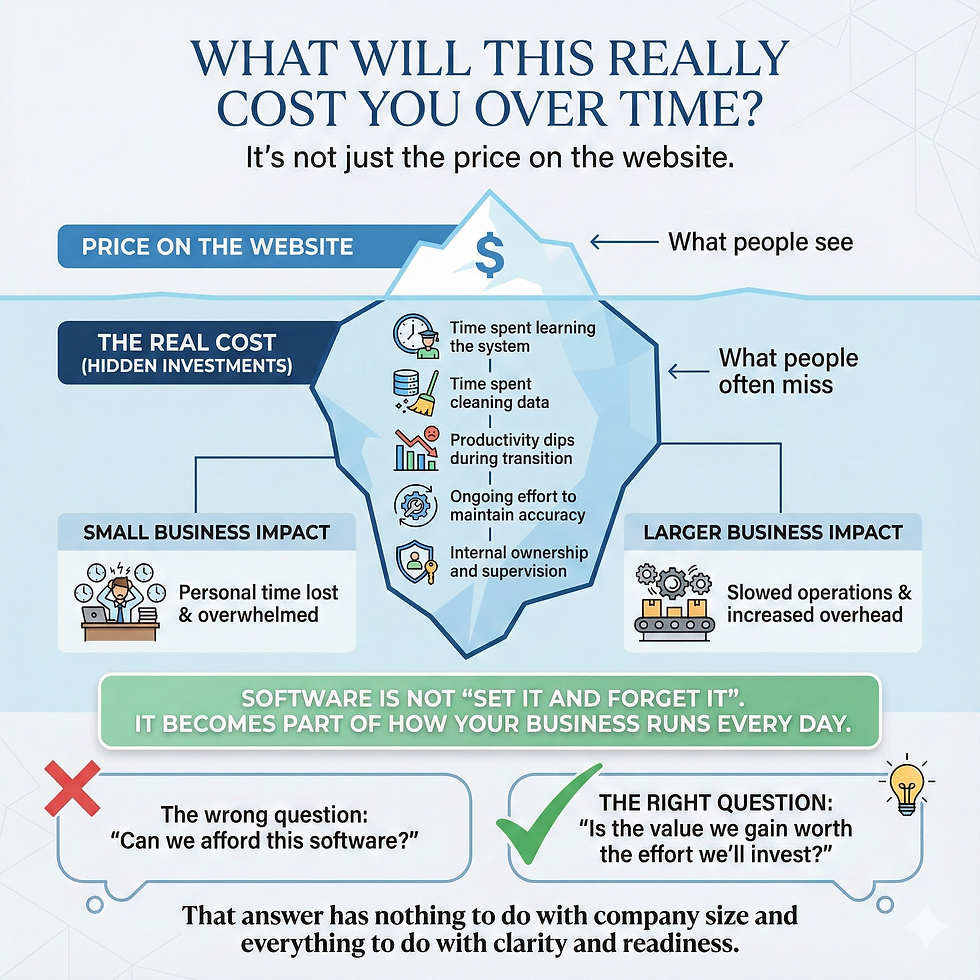
When people talk about software cost, they usually mean the price on the website.
But that’s only part of the picture.
The real cost includes:
Time spent learning the system
Time spent cleaning data
Productivity dips during transition
Ongoing effort to maintain accuracy
Internal ownership and supervision
A small business may feel this as personal time lost.
A larger business may feel it is slowing operations.
Either way, the impact is real.
Software is not “set it and forget it”. It becomes part of how your business runs every day.
So the right question isn’t: “Can we afford this software?”
It’s: “Is the value we gain worth the effort we’ll invest?”
That answer has nothing to do with company size and everything to do with clarity and readiness.
6. What risks are you taking on?

Every business handles sensitive information.
Customer details. Pricing. Financial data. Employee records.
So risk isn’t just a big-company concern.
Ask practical questions:
Who can see what?
What happens if access is misused?
What happens if the vendor shuts down?
What happens if the system is unavailable?
These aren’t worst-case scenarios. They’re normal operational questions.
You don’t need to be paranoid. You just need to be aware.
Clear answers build confidence for you and your team.
7. Who will own this after it’s implemented?

This is where many software projects quietly fail.
Not during purchase. Not during setup. But three months later.
When:
Data stops being updated
People revert to old habits
No one knows who’s responsible anymore
Every system needs ownership.
Someone who:
Understands the business
Understands the tool
Ensures people actually use it properly
This applies whether:
Your team has 2 people
Or 200 people
Without ownership, software slowly becomes optional.
And optional systems don’t survive.
The bigger truth most businesses learn too late
Software doesn’t fix broken businesses.
It reveals them.
If your business is clear even in simple ways, software strengthens that clarity. If your business relies on memory, individuals, and workarounds, software exposes that fragility.
This has nothing to do with size. Everything to do with how intentionally the business operates.
How Evanam Consulting Can Help
At Evanam Consulting, we believe the right software decision starts with clarity, not pressure.
We work with businesses to understand how work really happens, identify what truly needs to improve, and evaluate technology based on real business needs, not vendor promises or feature lists.
Whether that leads to a new system, better use of what you already have, or simply clearer direction, our focus is on helping you make informed, confident decisions that fit your business today and scale with you tomorrow.
Before you invest in any software, invest a little time in clarity, connect with Evanam Consulting and make a confident decision.
🌐 www.evanam.com 📧 hello@evanam.com 📱 +91 93639 77790


