
The Role of Business Consultants in Creating Value for Growing Companies


Growing a business is a demanding journey. As companies expand, leaders juggle customers, teams, operations, finances, and long-term goals, often at the same time. Many business owners are deeply committed, experienced, and hands-on. They know their business well and work tirelessly to keep things moving.
Yet, as growth accelerates, new challenges begin to surface. Decisions take longer. Teams feel stretched. Small issues repeat themselves. Progress feels harder than it should.
This is not a sign of poor leadership or lack of effort. It is a natural stage in the growth of any business.
At this point, the role of a business consultant becomes less about advice and more about value creation through clarity, structure, and perspective.
Growth Changes How a Business Behaves
In the early stages, businesses rely heavily on speed, flexibility, and personal involvement. Decisions are quick. Communication is informal. Owners are closely connected to every part of the operation.
As the company grows, the same ways of working start to feel strained.
More people are involved.
More decisions need alignment.
More customers expect consistency.
What once worked effortlessly now requires coordination.
Business consultants understand this transition. Their role is not to replace what already works, but to help the business adapt its way of operating to support the next stage of growth.
Value Creation Starts with Perspective
One of the most important contributions a business consultant brings is perspective.
Business owners operate from inside the business. Their view is shaped by daily responsibilities, immediate priorities, and constant problem-solving. This closeness is valuable, but it also makes it harder to step back and see the full picture.
Consultants work from the outside. They are not involved in daily decisions or internal history. This distance allows them to observe patterns, connections, and gaps that are difficult to notice from within.
This external perspective is not about finding faults. It is about revealing opportunities to work smarter, reduce friction, and support sustainable growth.
Identifying Patterns Behind Repeated Challenges

Many businesses face issues that seem unrelated on the surface.
A delay here.
A miscommunication there.
A customer escalation.
Owners often address these as individual incidents. Consultants look for repetition.
When similar problems keep appearing, they usually point to an underlying structure issue rather than isolated mistakes.
For example, repeated delays may indicate unclear decision authority. Frequent rework may signal missing checkpoints or unclear expectations.
By identifying these patterns, consultants help businesses address root causes instead of symptoms.
Bringing Clarity to How Work Actually Happens
There is often a gap between how work is supposed to happen and how it actually happens.
On paper, roles may be defined and responsibilities assigned. In reality, teams may rely on informal approvals, verbal instructions, or personal follow-ups to get things done.
As long as the team is small, this works. As the business grows, it introduces confusion and risk.
Consultants spend time understanding real workflows, not ideal ones. They observe how information flows, how decisions are made, and where work slows down. This clarity helps businesses strengthen execution without adding unnecessary complexity.
Reducing Hidden Effort and Operational Noise
Many growing companies are busy, but not always effective.
Teams may be putting in long hours while struggling with:
Repeated follow-ups
Duplicate data entry
Waiting for approvals
Unclear ownership of tasks
These issues rarely appear in reports, but they quietly drain time and energy.
A business consultant helps uncover where effort is being lost and where small structural improvements can unlock significant gains in productivity and morale.
Supporting Better Decision-Making
As businesses grow, decisions become more complex. More stakeholders are involved, and the impact of each decision increases.
Without clear decision frameworks, teams may hesitate or escalate unnecessarily. Owners may feel pulled into decisions that could be handled elsewhere with the right clarity.
Consultants help define decision boundaries, accountability, and escalation paths. This allows leaders to focus on strategic priorities while empowering teams to act with confidence.
A Real-World Example of Value Creation Through Business Consulting
Consider a mid-sized manufacturing company that has grown steadily over the years. Orders are increasing, the customer base is expanding, and the business has a strong reputation in its market.
From the owner’s point of view, things appear positive. Sales are coming in, the factory is busy, and customers continue to place repeat orders. At the same time, there is a growing sense of pressure.
Teams are constantly occupied.
Margins are tighter than expected.
Project timelines often feel stretched.
The owner is involved in many day-to-day decisions.
Nothing seems critically broken, but the business feels harder to manage than before.
When a business consultant begins working with the company, the focus is not on blaming people or questioning effort. Instead, the consultant observes how work flows across the organization.
What becomes visible is a pattern.
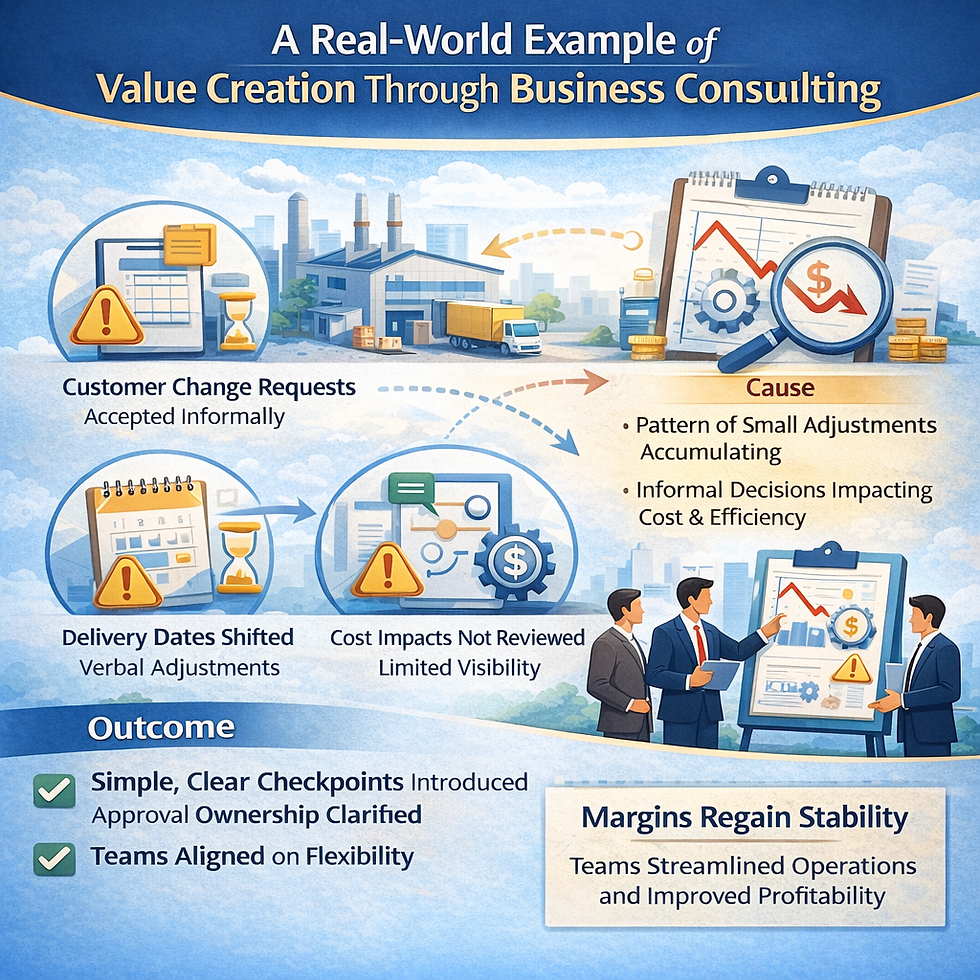
Customer requests frequently change after orders are confirmed. These changes are accepted informally to maintain good relationships. Delivery commitments are adjusted through verbal discussions. Cost implications of these changes are rarely reviewed in a structured way before work proceeds.
Each individual decision feels reasonable. Teams want to be helpful. Sales wants to keep customers satisfied. Operations wants to deliver on time.
Over weeks and months, these small adjustments accumulate. Extra effort becomes normal. Overtime increases quietly. Material usage varies slightly from estimates. None of this is immediately alarming, but together they begin to erode margins and create constant pressure.
The consultant’s role here is not to stop flexibility or slow down the business. Instead, value is created by making these patterns visible to leadership.
Once the business sees how informal decisions impact cost and capacity, simple changes are introduced.
Clear checkpoints are added before accepting scope changes.
Responsibilities for approvals are clarified.
Teams are aligned on when flexibility is appropriate and when it needs review.
These adjustments do not require major restructuring. They simply bring clarity to decisions that were already being made.
As a result, the business regains control. Teams feel less stressed. Margins stabilize. The owner spends less time resolving operational issues and more time focusing on growth.
This is a typical example of how business consultants create value, not by introducing complexity, but by helping companies see what is already happening and respond with clarity.
Aligning Teams Around Shared Priorities

Different teams often have different definitions of success.
Sales may focus on speed and volume.
Operations may focus on accuracy and efficiency.
Finance may focus on cost control.
All of these priorities are valid, but without alignment, they can pull the business in different directions.
Business consultants facilitate conversations that help teams understand how their goals connect and where trade-offs need clarity. This alignment reduces friction and improves collaboration across the organization.
Why Consulting Is Not About Control
A common misconception is that consultants impose rigid structures or restrict flexibility.
In reality, effective consulting enhances flexibility by creating clarity. When people know what is expected, who decides what, and how work flows, they spend less time guessing and more time delivering value.
The goal is not control. The goal is confidence.
Creating Value Through Calm and Clarity
One of the most understated benefits of business consulting is calm.
When leaders gain clarity on what matters, what can wait, and where to focus, the business feels lighter. Decisions become easier. Teams feel more confident. Growth feels intentional rather than exhausting.
This is where true value is created.
How Evanam Consulting Supports Growing Companies
At Evanam Consulting, we work with growing companies that want clarity, structure, and confidence as they scale.
Our approach is rooted in understanding how businesses actually operate, not just how they are supposed to operate. We focus on uncovering hidden friction, aligning teams, and helping leaders make better decisions with less effort.
We believe consulting is not about telling businesses what to do. It is about helping capable leaders and teams see their business more clearly and move forward with purpose.
Growth does not have to feel chaotic. With the right perspective and guidance, it can feel controlled, sustainable, and rewarding.
📩 Ready to take a clearer view of what’s working and what’s not? We’re here for you.
📱 +91 93639 77790


