
How to Build a Future-Proof Business in 2026 Even If You’re Not Technically Strong


As 2026 approaches, many business owners share a quiet concern.
They are experienced.
They understand customers.
They know how to run operations.
But they worry they are not technical enough for the future.
New tools, new terms, and constant talk of “digital transformation” can make it feel like success now belongs only to people who understand systems, dashboards, and software.
The reality is very different.
Businesses don’t fail because leaders are not technical.
They struggle because work becomes unclear, decisions become reactive, and teams lose confidence.
Future-proofing your business is not about learning technology.
It is about building clarity, stability, and adaptability into how work happens every day.
Let’s break this down calmly and practically.
1. Future-Proofing Starts With Understanding How Your Business Actually Works

Many businesses think they know how work flows.
In reality, most work happens through:
Verbal instructions
Habit
“This is how we’ve always done it”
Over time, this creates hidden confusion.
An Example
Consider a mid-sized manufacturing unit in Coimbatore.
Orders are coming in regularly. The factory is busy. Yet:
Sales keeps following up with production
Production keeps waiting for confirmations
Dispatch often rushes at the last minute
No one is doing anything wrong.
But the flow of work is not clearly understood end-to-end.
Future-ready businesses take a step back and ask:
What happens from enquiry to delivery?
Where do delays repeat?
Where do people rely on memory instead of clarity?
You don’t need charts or software to begin. You need honest observation.
2. Clarity Is More Valuable Than Speed
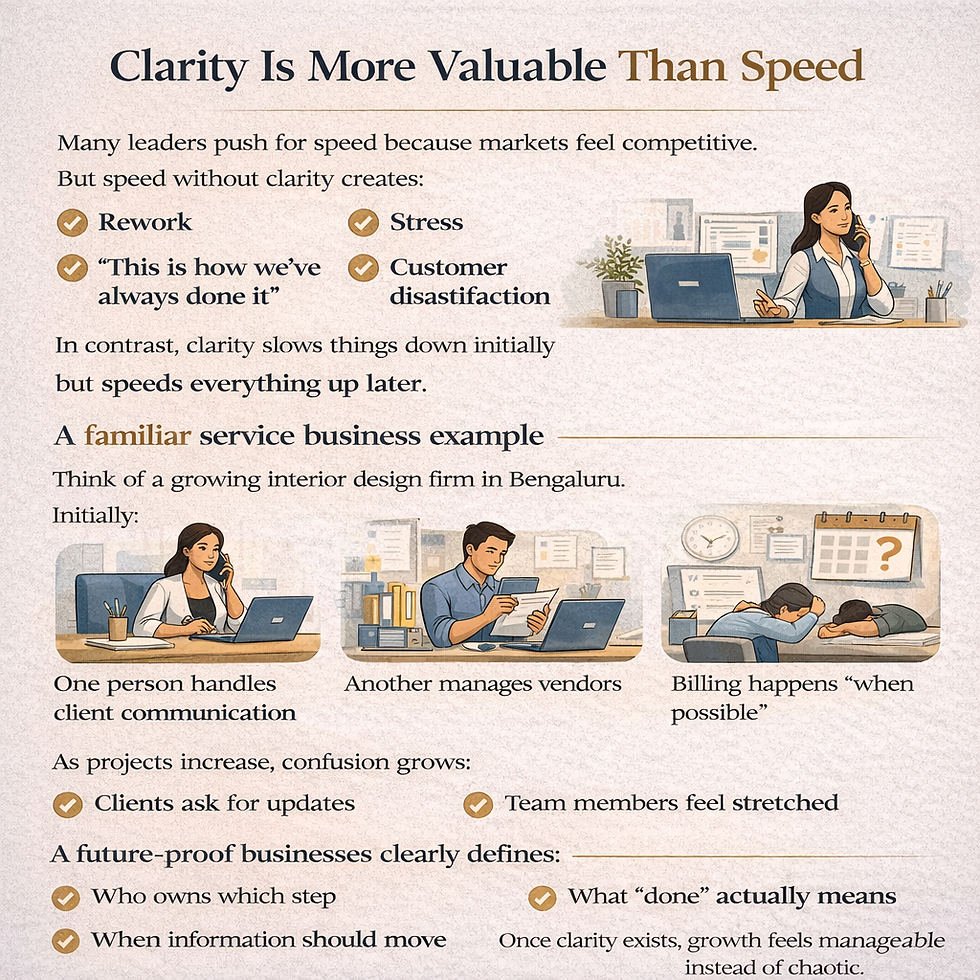
Many leaders push for speed because markets feel competitive.
But speed without clarity creates:
Rework
Stress
Blame
Customer dissatisfaction
In contrast, clarity slows things down initially but speeds everything up later.
A familiar service business example
Think of a growing interior design firm in Bengaluru.
Initially:
One person handles client communication
Another manages vendors
Billing happens “when possible”
As projects increase, confusion grows:
Clients ask for updates
Payments get delayed
Team members feel stretched
The issue is not effort.It is unclear responsibility and unclear flow.
A future-proof business clearly defines:
Who owns which step
When information should move
What “done” actually means
Once clarity exists, growth feels manageable instead of chaotic.
3. Strong Businesses Fix Daily Friction, Not Just Big Problems

Many leaders wait for big issues to justify change.
But future-proofing happens when you address small daily friction points.
Examples of friction:
Repeating the same information multiple times
Searching for old emails or messages
Waiting for approvals without knowing timelines
Fixing the same mistakes again and again
Indian SME reality
In many trading and distribution businesses, especially family-run ones:
Order details are shared on WhatsApp
Invoices are prepared separately
Follow-ups depend on individual memory
This works until the volume increases.
Future-ready businesses don’t abandon familiar ways immediately.They bring structure gently, step by step.
They ask:
“What part of our daily work causes the most confusion?”
That is always the right place to start.
4. Processes Should Feel Natural, Not Forced

A process should make work easier, not heavier.
If people avoid a process, it means:
It is too complex
It doesn’t reflect real work
It was designed without listening
Realistic example
A Chennai-based professional services firm tried to standardise reporting.
Initially, they created a detailed format.The team found it difficult and avoided using it.
Instead of blaming people, leadership simplified:
Only essential information
Clear purpose
Easy structure
The result?People started using it willingly.
Future-proof businesses design processes that:
Match how people already work
Reduce mental load
Improve consistency naturally
5. Technology Is a Support System, Not the Foundation

This is where many leaders feel anxious.
They think:“If I don’t understand technology, I’ll make the wrong decisions.”
But good decisions don’t start with tools.
They start with understanding needs.
You don’t need to know:
How systems are built
Technical features
Industry buzzwords
You do need to know:
Where visibility is missing
Where delays hurt customers
Where errors cost time or trust
A simple Indian retail example
A growing retail chain doesn’t need complex analytics to start.
They first need clarity on:
Which items sell consistently
Where stock shortages happen
Which stores face repeated issues
When this understanding exists, choosing tools becomes easier and less risky.
Future-proof businesses let technology quietly support clarity, not replace thinking.
6. People Confidence Is the Real Competitive Advantage

Markets change. Tools change.People stay.
When people feel unsure, they resist change.When people feel confident, they adapt naturally.
Confidence grows when:
Expectations are clear
Change is explained calmly
Support is available
Indian workplace reality
In many organisations, employees worry: “Will this change make my job harder?” “Will I be blamed if I don’t understand?”
Future-ready leaders address this openly.
They communicate:
What is changing
What is not changing
How people will be supported
This reduces fear and builds trust.
7. Stability Enables Growth, Not the Other Way Around

There is a myth that stability slows growth.
In reality, unstable systems:
Drain leadership energy
Create constant firefighting
Prevent long-term thinking
Stable businesses:
Handle growth calmly
Absorb change better
Make thoughtful decisions
Example from Indian scale-ups
Many fast-growing startups face this problem: Rapid expansion without internal clarity leads to burnout and reversals.
The ones that sustain growth invest early in:
Clear workflows
Decision discipline
Team alignment
That is what makes them future-ready.
8. Progress Matters More Than Perfection

You don’t need to “fix everything” in 2026.
You need:
Slightly better visibility than last year
Fewer repeated issues
More confident teams
Calmer decision-making
Future-proofing is not a one-time project. It is a mindset of continuous improvement.
Small improvements, done consistently, compound quietly.
Building Readiness That Lasts
Building readiness for the future is not about reacting quickly to every new trend or mastering complex tools. It is about strengthening how work is understood, how decisions are made, and how people experience change in their day-to-day roles. When clarity becomes part of everyday operations, and improvement happens steadily, organisations are better prepared to adapt not just once, but repeatedly over time.
At Evanam Consulting, we work alongside organisations to reinforce these fundamentals. Our approach focuses on bringing structure, confidence, and stability into everyday work, so businesses can grow and evolve without unnecessary pressure or disruption. This is how readiness becomes sustainable, rooted in understanding, supported by people, and resilient to change.


